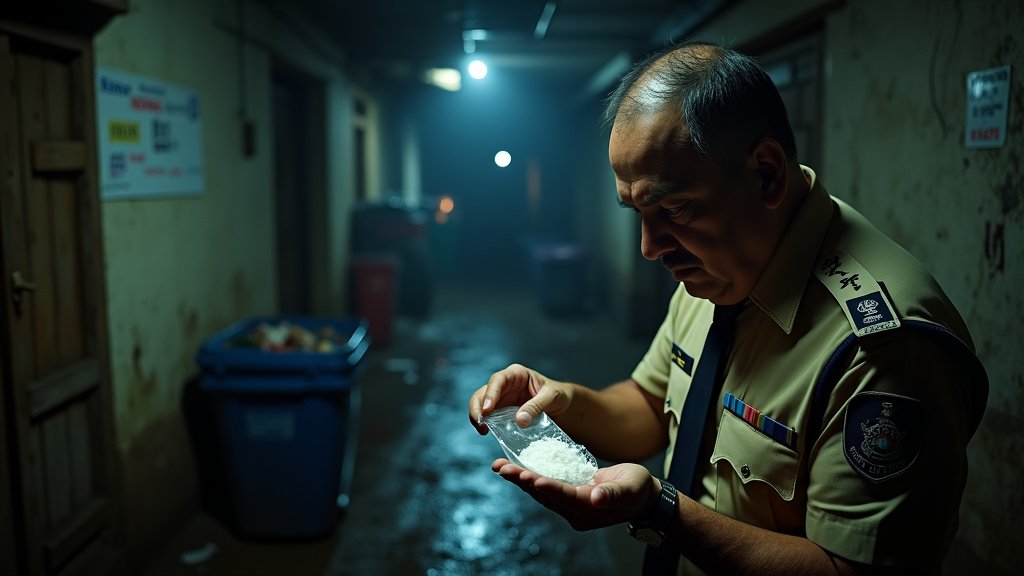
In a significant operation targeting the drug menace, the Mangaluru City Crime Branch (CCB) police have arrested two individuals, Abdul Salam (39) and Mohammed Nasir (28), for allegedly distributing banned narcotic substances, specifically MDMA, to college students and the general public. The arrests, made on November 4 and November 6 respectively, led to the seizure of MDMA worth ₹2.4 lakh in total, underscoring the persistent threat of drug peddling in the region.
Mangaluru Operation Details
During separate raids, CCB sleuths apprehended Abdul Salam, an auto-rickshaw driver, near the Mangaluru port and dock area. He was found to be selling MDMA while operating his auto-rickshaw. Police recovered 24.57 grams of MDMA valued at approximately ₹1.2 lakh from him. The seized items also included his auto-rickshaw, a mobile phone, and a weighing machine, with the total property value estimated at around ₹2.3 lakh. A case was registered at the Mangaluru South Police Station under the Narcotic Drugs and Psychotropic Substances (NDPS) Act.
Following a tip-off, a similar operation on November 6 led to the arrest of Mohammed Nasir in the Boliyaru area. Officers seized MDMA worth ₹1.2 lakh from Nasir, along with his motorcycle and mobile phone. The total estimated value of seized items in this operation was around ₹2.05 lakh. A case was registered at the Konaje Police Station.
Police Commissioner Sudheer Kumar Reddy indicated that the investigation is ongoing, with suspicions of more individuals being involved in the MDMA supply network, and efforts are underway to trace and apprehend them.
A Wider Network of Drug Busts
These arrests in Mangaluru are part of a larger, concerning trend of drug-related seizures and arrests being reported across various locations in India. The initial context highlights several other significant busts, including the seizure of 22 kg of ganja in Madanapalle and the apprehension of a gang dealing in MDMA and ganja in Rajendranagar.
Further afield, authorities in Sangareddy seized 12.8 kg of marijuana valued at ₹4.5 lakh, while another operation in Nampally resulted in the confiscation of 2.1 kg of ganja. These related incidents collectively paint a grim picture of the pervasive nature of drug trafficking and peddling across different states.
Karnataka’s Intensified Battle Against Drugs
Karnataka, and particularly its cities like Bengaluru and Mangaluru, have been at the forefront of this challenge. Statistics indicate that Mangaluru and its surrounding educational hubs account for a significant portion of drug-related cases registered in the state. In response to the escalating problem, the Karnataka government has bolstered its efforts, forming a ministerial task force and proposing stricter laws with harsher penalties for drug peddlers. An Anti-Narcotics Task Force was established in August 2025 to enhance monitoring and enforcement at the police station level, alongside training programs for officers.
While the number of registered narcotics cases in Karnataka has seen a drop in recent years, concerns remain regarding conviction rates, often attributed to inadequate evidence and poor documentation. The state police are intensifying their efforts, with Mangaluru City police alone having arrested 948 individuals in 2023 and seizing drugs worth ₹1.7 crore. In July 2025, Mangaluru police also destroyed substantial quantities of seized narcotics, including cannabis and MDMA.
Youth Vulnerability and Evolving Drug Trends
The growing menace of drug abuse among youth in India presents a critical public health crisis. Factors such as socio-economic challenges, unemployment, mental health issues, and performance pressure contribute to increased vulnerability among adolescents and young adults, aged 15-35. These young individuals often turn to substances as a coping mechanism or escape. Key drugs of concern include alcohol, opioids, stimulants, and notably, cannabis, which remains the most widely used illicit substance globally and in India. Synthetic drugs, like MDMA, are also increasingly prevalent and pose a significant threat.
Experts also point to the glamourisation of intoxication in popular media as a trend accelerating substance use among impressionable age groups. The consequences extend beyond individual health, leading to increased criminal activities, academic failures, and family disruptions, impacting social stability and economic productivity.
Law Enforcement’s Persistent Pursuit
Government agencies are employing multi-pronged strategies to combat drug trafficking, including strengthening inter-agency coordination through the NCORD mechanism and developing specialized task forces. The use of technology, such as the NIDAAN database for tracking offenders, is also being integrated into enforcement efforts. However, challenges persist, including the sophistication of drug smuggling networks that increasingly utilize dark nets, cryptocurrencies, and courier services.
The fight against drug trafficking and abuse is an ongoing, dynamic challenge. The recent arrests in Mangaluru, coupled with continuous crackdowns across the country, highlight the persistent efforts of law enforcement. However, comprehensive strategies involving education, mental health support, community engagement, and rehabilitation remain crucial in paving the way for a drug-free future. The news surrounding these busts serves as a stark reminder of the urgent need for continued vigilance and collective action against this pervasive societal threat.