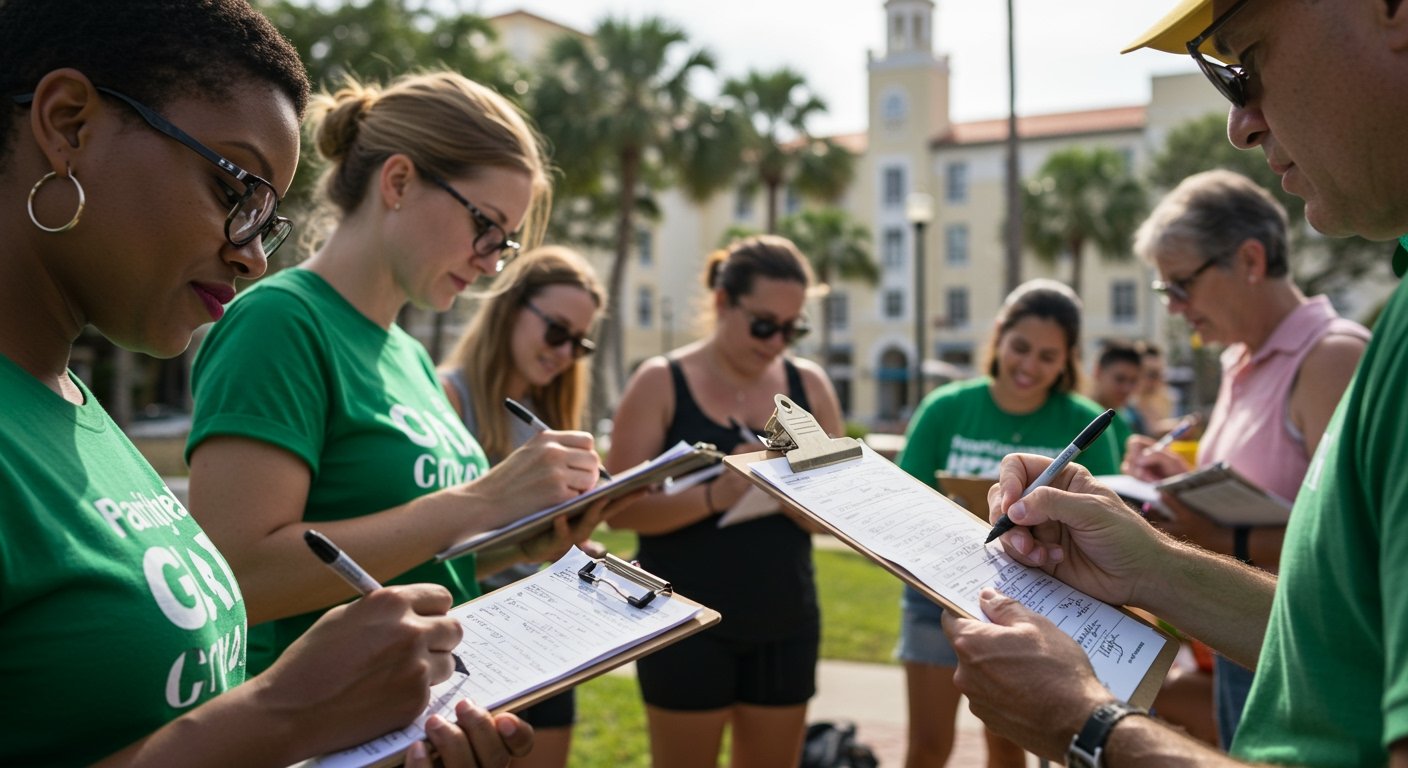
TALLAHASSEE, FL – Proponents of a proposed constitutional amendment aimed at legalizing recreational marijuana use in Florida have announced a significant milestone, submitting more than 600,000 valid petition signatures towards their 2026 ballot effort. According to data updated Tuesday on the state Division of Elections website, the campaign has formally filed 613,206 verified signatures.
The initiative, spearheaded by the political committee Smart & Safe Florida, marks the latest attempt to bring adult-use cannabis before Florida voters. This current proposal closely mirrors a measure that appeared on the 2024 ballot but ultimately failed to secure the requisite 60 percent voter support mandated by Florida law for constitutional amendments.
Advancing Towards Ballot Qualification
The submission of over 600,000 signatures demonstrates substantial organizational capacity and public interest in the issue. Crucially, the Smart & Safe Florida committee has surpassed the initial threshold of 220,016 valid signatures necessary to trigger key procedural reviews. Reaching this benchmark initiates the process where the proposal undergoes scrutiny by both the Florida Supreme Court, which reviews the ballot language for clarity and adherence to single-subject rules, and the Financial Impact Estimating Conference, which analyzes the potential fiscal effects on the state.
While the 220,016-signature mark is a critical step for judicial and financial review, it is only the beginning of the path to ballot qualification. To successfully place the measure before voters in November 2026, Smart & Safe Florida must ultimately gather a total of at least 880,062 valid signatures from registered voters statewide. Additionally, the campaign must meet specific signature distribution requirements across a certain number of the state’s congressional districts, ensuring broad-based geographic support.
Legal Challenges Parallel Signature Drive
The push to collect signatures for the 2026 ballot is unfolding concurrently with legal challenges against a new state law that advocates argue imposes burdensome restrictions on the citizen-initiative process. Smart & Safe Florida, along with other political committees involved in various ballot efforts, has filed suit in federal court, contending that the new regulations hinder their ability to effectively gather signatures and communicate with voters.
These committees are seeking a preliminary injunction in federal court to block parts of the contested law while the litigation proceeds. U.S. District Judge Mark Walker presided over a hearing regarding the committees’ requests for injunctive relief last week. However, as of Tuesday, Judge Walker had not yet issued a ruling on the motions.
Context: The 2024 Attempt and Future Prospects
The decision by Smart & Safe Florida to target the 2026 ballot follows the outcome of their similar 2024 initiative. Despite significant financial backing and extensive campaigning, the measure did not achieve the supermajority approval needed under Florida’s constitutional amendment rules. The 60 percent threshold is a significant hurdle for any proposed change to the state constitution, requiring broad consensus across the electorate.
The campaign’s renewed effort for 2026 suggests continued commitment to the goal of legalizing adult-use cannabis, framing it as a matter of personal liberty and potential economic benefit. By securing over 613,000 signatures early in the process, the proponents demonstrate momentum and aim to build on their previous efforts. The success of the 2026 campaign will depend not only on gathering the remaining required signatures but also on the outcome of the ongoing legal challenge to the state’s ballot initiative laws and the political landscape two years from now.
The journey to the ballot is complex, involving not just grassroots signature collection but also navigating legal interpretations by the state Supreme Court and potential legislative or judicial changes impacting the process itself. The progress reported by Smart & Safe Florida marks a notable step in this multi-faceted endeavor as they work towards securing a place for the recreational marijuana question on the November 2026 general election ballot.