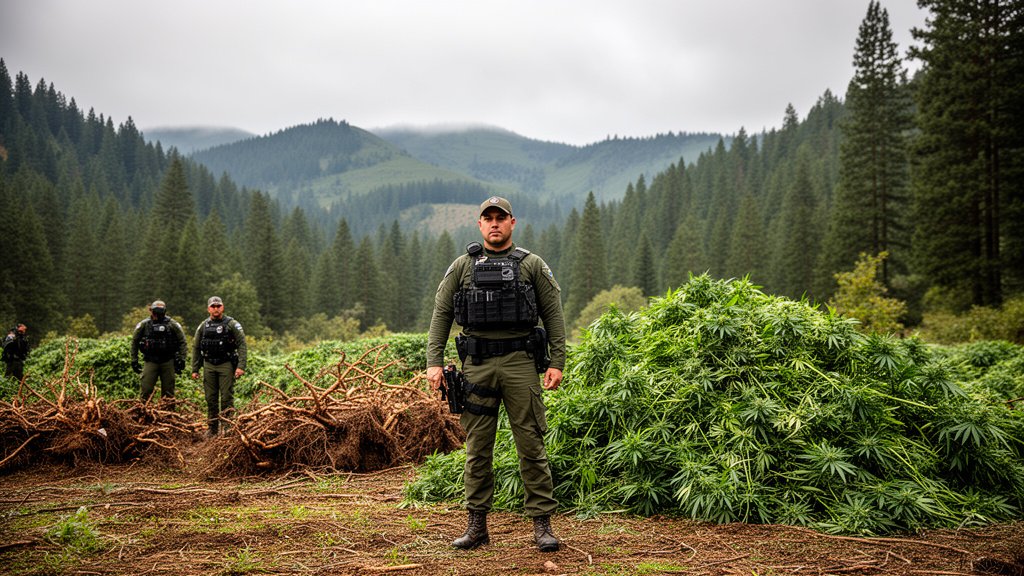
The Mendocino County Sheriff’s Office (MCSO) has successfully executed a major multi-week enforcement operation targeting illegal cannabis cultivation sites, resulting in the eradication of 173,000 plants and the seizure of 26 firearms. This coordinated effort, which involved regional and federal partners, focused heavily on the rural zones of Covelo and Laytonville, areas that have long been the epicenter of Northern California’s illicit cannabis trade. The operation underscores the persistent challenges law enforcement faces in curtailing black-market production that often operates outside the bounds of California’s strict regulatory framework.
Key Highlights
- Massive Seizure: A total of 173,000 illicit cannabis plants were identified, uprooted, and destroyed during the operation.
- Firearm Confiscation: Authorities successfully seized 26 firearms, highlighting the dangerous intersection of organized black-market cultivation and armed criminality.
- Strategic Locations: The enforcement sweep prioritized known hotspots, particularly in the Covelo and Laytonville regions of Mendocino County.
- Multi-Agency Collaboration: The success of the sweep was attributed to joint efforts between the MCSO, federal partners, and regional law enforcement entities working to mitigate environmental and public safety threats.
The Crisis of Unregulated Cultivation in the Emerald Triangle
The scale of this recent operation in Mendocino County reveals the sheer magnitude of the black market that persists despite the legalization of recreational cannabis in California. While the state has established a rigorous licensing system for cultivation, a substantial shadow industry continues to operate, often characterized by its disregard for both labor laws and environmental standards. The MCSO’s Marijuana Enforcement Team (MET) has been tasked with the difficult job of dismantling these sites, which are frequently found on private and public lands alike, often utilizing illegal water diversions and toxic chemicals that threaten the local ecosystem.
The Nexus of Violence and Cultivation
One of the most alarming aspects of this enforcement sweep is the recovery of 26 firearms. The presence of weaponry at these cultivation sites is a stark indicator of the potential for violence associated with the illicit trade. In many cases, these grow operations are not the work of individual small-scale farmers, but are instead controlled by larger criminal syndicates that employ armed personnel to guard their crops. This transforms agricultural zones into militarized landscapes, creating significant safety risks for local residents and deputies alike. By removing these weapons from the field, law enforcement is not merely enforcing agricultural law; they are actively disrupting the infrastructure of violent criminal enterprises operating within the county.
Environmental Degradation and Remediation
The environmental impact of the illegal cannabis trade is profound. These operations often involve the unauthorized diversion of local water sources, which can deplete streams and rivers essential for local wildlife, particularly during drought conditions. Furthermore, the use of banned pesticides, rodenticides, and herbicides is rampant in illegal grows. These chemicals leach into the soil and groundwater, causing long-term damage to the watershed of the Eel River and surrounding protected areas. The MCSO operation represents a critical intervention in stopping the further contamination of Mendocino County’s natural resources, as the remediation of these contaminated sites often falls to the taxpayer and requires years of ecological restoration efforts.
The Economic Distortion of the Legal Market
There is a complex economic reality underpinning these enforcement efforts. Licensed, compliant cannabis cultivators in California face significant tax burdens, testing requirements, and regulatory overhead. The persistent existence of massive, illegal grow operations creates an unfair and unsustainable market dynamic. By producing cannabis at a fraction of the cost—without the burden of compliance—these illegal operators undercut the legal market, driving down prices to a level where compliant, small-scale legacy farmers struggle to survive. The MCSO’s crackdown is therefore not just a matter of law enforcement, but also a measure intended to protect the viability of the regulated, tax-paying cannabis industry that the state of California has worked to build.
Future Implications for Enforcement
Moving forward, the success of this multi-week sweep suggests that localized, high-intensity enforcement is an effective strategy for the MCSO. However, the recurring nature of these grows indicates that enforcement alone may not be a long-term solution. Many of these sites are re-cultivated in subsequent seasons, leading to a “whack-a-mole” dynamic that strains law enforcement resources. Future strategies may require a combination of increased aerial surveillance, more robust inter-agency communication, and stiffer penalties for landowners who knowingly lease their property to illicit cultivators. As Mendocino County continues to navigate its identity in a post-legalization world, balancing the rights of legal operators with the imperative to suppress criminal activity remains a paramount challenge for county officials.
FAQ: People Also Ask
Q: Why does the MCSO focus so heavily on cannabis enforcement?
A: While cannabis is legal in California, it is subject to strict state regulations. The MCSO enforces laws against illegal cultivation to protect public safety, reduce the influence of organized crime, prevent the theft of water resources, and stop the illegal use of toxic chemicals in the environment.
Q: What happens to the seized cannabis plants?
A: Cannabis seized during these operations is processed as evidence and subsequently destroyed. Unlike legal, regulated products, these plants are often contaminated with banned pesticides and are therefore not fit for public consumption or resale.
Q: How does the MCSO identify illegal grow sites?
A: The MCSO utilizes various methods, including aerial surveillance, tips from concerned citizens, and investigations into water usage and infrastructure anomalies, to pinpoint illegal cultivation operations hidden in rural or forested areas.
Q: Are these sites always connected to large cartels?
A: Many of the large-scale operations dismantled by the MCSO are linked to sophisticated criminal organizations that operate multi-state or international networks. However, the operations also include smaller, non-compliant grows that are part of a broader “shadow economy.”