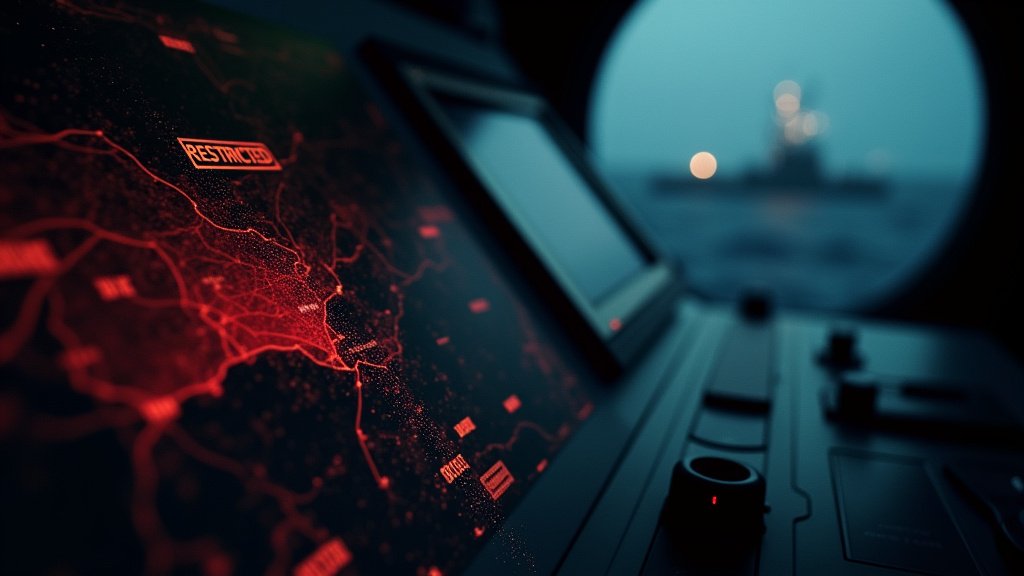
The U.S. military has officially commenced a comprehensive blockade of all Iranian ports and coastal areas today, April 13, 2026, marking a significant escalation in the ongoing Middle Eastern conflict. Announced by U.S. Central Command (CENTCOM), the operation is designed to exert maximum economic and strategic pressure on the Iranian regime. The move has triggered immediate global uncertainty, with energy markets anticipating sharp spikes in oil prices as the Strait of Hormuz—the world’s most critical maritime chokepoint—faces severe restrictions. While the U.S. maintains the blockade is necessary to curb Iranian aggression, the unilateral nature of the decision has caused a visible rift within the Western alliance, with the United Kingdom and France distancing themselves from the enforcement measures.
Key Highlights
- Blockade Enforcement: CENTCOM has enacted a blockade on all Iranian ports and coastal areas in the Persian Gulf and the Gulf of Oman, impacting both domestic Iranian logistics and international shipping lanes.
- Western Divergence: The U.K. government, led by Prime Minister Keir Starmer, has formally stated it will not support the blockade, emphasizing a desire to avoid direct military entanglement in the broader conflict.
- Economic Volatility: Global oil markets are reacting sharply, with energy analysts warning that the disruption of traffic through the Strait of Hormuz could threaten a significant percentage of global oil transit, pushing prices toward record 2026 highs.
- Diplomatic Friction: President Emmanuel Macron is coordinating with European partners to host a diplomatic conference aimed at restoring navigation rights, effectively positioning Europe as a mediator separate from the U.S.-led belligerent posture.
Geopolitical Escalation: The Strait of Hormuz Standoff
The implementation of the naval blockade represents a critical pivot point in the 2026 geopolitical landscape. For months, the region has been defined by a series of drone strikes, ballistic missile exchanges, and cyber warfare. However, moving from targeted strikes to a full maritime blockade constitutes an act of economic warfare with global repercussions. By cordoning off Iranian ports, the United States is attempting to force a diplomatic breakthrough by squeezing the regime’s primary revenue stream: oil and petrochemical exports.
The Strategic Gamble of CENTCOM
The strategic rationale presented by the Pentagon focuses on “enforced neutrality” and security. CENTCOM officials have clarified that the blockade is intended to be “enforced impartially,” yet the reality of naval interdiction in a congested waterway like the Persian Gulf creates an inherently dangerous operational environment. Military analysts argue that this move is a high-stakes gamble; if Iran retaliates by attempting to close the strait entirely or mining the shipping lanes, the blockade could quickly devolve from an economic pressure campaign into a full-scale regional war. The tactical deployment of naval assets around the Strait of Hormuz is designed to deter Iranian naval vessels and IRGC (Islamic Revolutionary Guard Corps) speedboats, but the margin for error in such proximity is razor-thin.
The European Split and Diplomatic Frictions
One of the most consequential outcomes of today’s announcement is the visible fragmentation of NATO-aligned policy. Prime Minister Keir Starmer’s rejection of the blockade signals that London is unwilling to risk a direct, open-ended conflict with Tehran, despite the long-standing “special relationship” with Washington. This divergence is mirrored by France’s diplomatic maneuvering. President Macron’s push for a “peaceful multinational” conference suggests that European powers are increasingly wary of the U.S. administration’s “finish the job” rhetoric. This geopolitical rift creates a complex environment for international shipping firms: they are now caught between U.S. enforcement protocols and the diplomatic assurances of European powers, leading to chaotic maritime insurance landscapes.
Economic Ripples: Energy Markets on Edge
The economic impact of this blockade cannot be overstated. The Strait of Hormuz handles approximately one-fifth of the world’s total oil consumption. Even the threat of restricted passage is enough to drive commodity volatility. Markets are currently pricing in a “risk premium” that could persist as long as the blockade continues. If the situation does not de-escalate within the next 48 to 72 hours, we are likely to see a ripple effect in global manufacturing, transport, and consumer energy costs. This comes at a precarious time, as many global economies are already struggling with inflationary pressures linked to earlier phases of the 2026 conflict. Investors are closely watching not just the naval movements, but also the rhetoric coming out of Beijing and Moscow, both of whom have interests in maintaining maritime flow.
FAQ: The New Middle Eastern Conflict
Q: How will the blockade impact global gas prices?
A: Analysts expect immediate, significant volatility. Because the Strait of Hormuz is a key transit point for liquefied natural gas and oil, uncertainty regarding supply flow usually leads to sharp, speculative price increases in energy commodities.
Q: Why is the U.K. refusing to support the U.S. on this?
A: The U.K. and other European nations are prioritizing the avoidance of direct war with Iran. They are attempting to separate “freedom of navigation” operations from the U.S. administration’s offensive economic pressure campaign.
Q: What is the risk of a full-scale naval confrontation?
A: The risk is high. When naval forces block coastal areas, the potential for accidental engagement or miscalculation by IRGC naval units increases exponentially, which could lead to rapid escalation and potential retaliatory strikes across the region.
Q: Are commercial vessels being targeted?
A: While CENTCOM states the blockade is impartial, commercial vessels entering or leaving Iranian ports are now effectively stuck or restricted. This forces shipping companies to reroute, causing massive delays in global logistics.