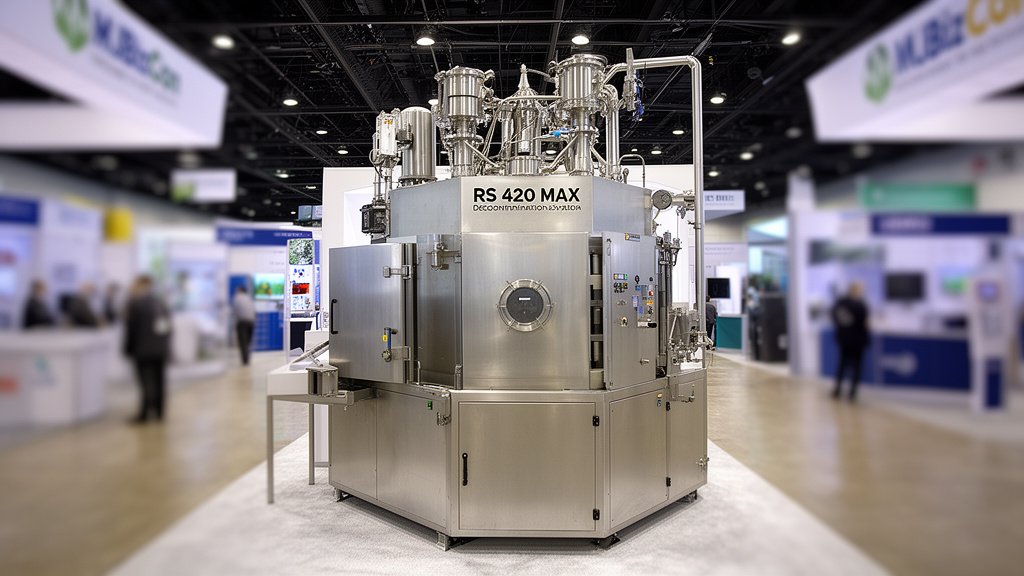
In the high-stakes environment of commercial cannabis cultivation, operational downtime is not merely a nuisance—it is a direct hit to the bottom line. At MJBizCon 2026, Rad Source Technologies, the industry standard in x-ray-based decontamination, addressed this critical pain point by unveiling the updated RS® 420 MAX, featuring their groundbreaking Uptime Assurance™ technology. By introducing true system redundancy to their high-capacity platform, Rad Source is fundamentally altering how cultivators approach facility throughput and inventory security.
The Cost of Downtime in Commercial Cultivation
For large-scale operations, the decontamination process is the final bridge between harvest and market readiness. When a system goes offline, the bottleneck created can delay shipping schedules, jeopardize product shelf life, and disrupt supply chain commitments. Historically, cultivators have been forced to balance the high-volume benefits of large-scale machines against the inherent risks of single-point failure. The updated RS® 420 MAX effectively eliminates this trade-off.
Anatomy of Uptime Assurance: Engineering Redundancy
The core innovation of the 2026 iteration of the RS® 420 MAX is the introduction of Uptime Assurance™. At the heart of the RS® 420 MAX system are two proprietary QUASTAR® emitters. In previous versions, the failure of a single emitter would necessitate an immediate system shutdown to maintain the integrity of the decontamination process.
With the new Uptime Assurance™ feature, the system logic is now capable of real-time monitoring and autonomous failover management. If one of the two QUASTAR® emitters experiences a performance degradation or failure, the system automatically recalibrates to maintain operational status. While throughput may be adjusted to accommodate the single-emitter workflow, the system does not cease functioning. This allows the facility operator to complete the current batch processing rather than scrambling to manage a sudden, unprogrammed halt.
The Technological Foundation: QUASTAR® Emitters
Rad Source has long utilized their proprietary QUASTAR® x-ray technology, which provides a non-destructive, chemical-free method to achieve compliance. Unlike thermal or chemical treatments, QUASTAR® utilizes controlled x-ray energy to penetrate deep into the flower, eliminating pathogens such as Aspergillus, E. coli, and Salmonella without compromising terpene profiles, moisture content, or cannabinoid potency. The integration of Uptime Assurance™ ensures that this delicate balance is maintained even during equipment anomalies, providing a level of reliability previously unseen in the sector.
Market Impact and Operational ROI
The introduction of this redundancy feature serves as a direct response to the maturing needs of the commercial cannabis market. As state regulations tighten and quality control standards become more rigorous, the demand for ‘always-on’ technology has surged. By minimizing the risk of unplanned downtime, the RS® 420 MAX provides operators with a more predictable ROI. Maintenance can now be scheduled during off-peak hours rather than occurring as a forced emergency, allowing for better allocation of labor and resource planning.
Evolution of Cannabis Safety Standards
The shift toward integrated reliability is a bellwether for the broader cannabis industry. In the early stages of legalization, focus was primarily on volume and extraction efficiency. Today, the focus has shifted toward institutional-grade reliability and supply chain consistency. The RS® 420 MAX represents the ‘industrialization’ of cannabis, moving away from boutique, finicky hardware toward robust, redundant systems that would feel at home in pharmaceutical or food-grade processing facilities.
Future Predictions: The Era of Smart Processing
Looking ahead, the inclusion of Uptime Assurance™ is likely just the beginning of a larger ‘smart machine’ trend within cannabis processing. We can expect future iterations of systems like the RS® 420 MAX to include predictive maintenance AI—sensors that warn operators of a potential QUASTAR® emitter failure weeks before it occurs. This predictive capability, coupled with the currently deployed redundancy, will effectively move cannabis decontamination from a reactive maintenance model to a proactive, ‘zero-downtime’ paradigm.
Economic Implications for Large-Scale Facilities
For MSOs (Multi-State Operators) and large-scale, vertically integrated firms, the economic math is straightforward. A single hour of unexpected downtime in a high-volume facility can result in thousands of dollars in lost throughput and labor inefficiencies. By reducing the frequency of hard stops, the updated RS® 420 MAX protects the facility’s output velocity. When scaled across multiple sites, the compounding benefit of Uptime Assurance™ becomes a significant competitive advantage, allowing firms to operate with leaner, more efficient teams while maintaining total compliance with state-mandated safety regulations.
Seamless Integration with Existing Workflows
Crucially, the updated RS® 420 MAX does not require a complete overhaul of facility layout. By maintaining the same physical footprint and throughput capacity of its predecessor while adding the redundancy layer, Rad Source has ensured that legacy clients can upgrade their capabilities without undergoing costly facility re-engineering. This modular approach to upgrades is essential for firms balancing growth with capital expenditure constraints in an increasingly competitive economic climate.