In the realm of contemporary theater, set designer August Henney is carving a unique niche, breathing new life into classic narratives through immersive and conceptually rich environments. His latest work, a bold reimagining of Mary Shelley’s life and the genesis of her seminal novel Frankenstein in the Rorschach Theatre’s production of “So Late Into the Night,” exemplifies his distinctive artistic vision.
Reimagining Literary Foundations
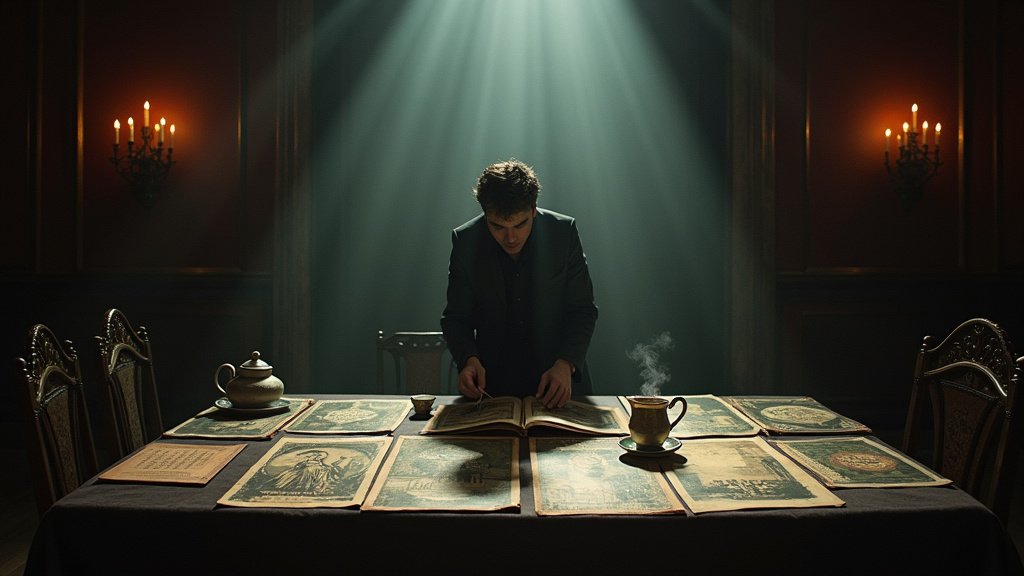
“So Late Into the Night” plunges audiences into an imagined 1816 gathering at Villa Diodati, Switzerland, where Mary Shelley, Percy Bysshe Shelley, Lord Byron, Claire Clairmont, and John Polidori famously challenged each other to write ghost stories. This historical moment, credited with birthing Shelley’s Frankenstein, is transformed into a contemporary rock musical. August Henney’s set design for this production is not merely a backdrop but an active participant in the narrative, pulling the historical figures and their fictional creations into a vibrant, anachronistic dialogue. His approach to translating the script’s essence involves an intense focus on words that spark inspiration, which he then uses to create collages that lay the foundation for his visual concepts. For this production, Henney has conceived a striking environment that blends the historical grandeur of Lord Byron’s Newstead Abbey with a decidedly modern, edgy aesthetic. A massive Victorian dining table, which often serves as the primary stage, is flanked by imposing drapes and unexpectedly juxtaposed with modern rock and roll posters, creating a visual lexicon that bridges centuries. The production itself is infused with music, featuring an onstage rock band called “The Shelleys,” whose conceptual album about the literary figures adds another layer of contemporary relevance to the timeless tale.
The Art of Immersive Experience
Henney is celebrated for his ability to craft theatrical experiences that deeply engage the audience, often by blurring the lines between spectator and participant. In “So Late Into the Night,” this immersion is palpable. He strategically seats audience members around the expansive dining table, inviting them into the intimate, and at times unsettling, world of the literary titans. This bold choice ensures that the historical drama unfolds not just before them, but, in a sense, among them. This immersive strategy is a hallmark of Henney’s design philosophy, aiming to create a sensory and emotional connection that resonates long after the curtain falls. His work often evokes a sense of “transcendent liminality,” where the audience is left in a state of heightened awareness, caught between different realities. The production’s blend of gothic horror and spirited music underscores the thematic exploration, making it a trending topic in current theatrical discussions.
A Transformative Journey: Identity and Education
Henney’s artistic evolution is deeply intertwined with his personal journey. Identifying as a trans gay man, he has spoken about how his relocation to Washington, D.C., and his subsequent studies in scenic design at the University of Maryland (UMD) proved to be a profoundly transformational experience. He credits the university environment with providing him a safe space to explore and affirm his identity, noting, “the universe puts people in places.” His time at UMD, he explained, placed him “in the right place” among individuals who helped him embrace aspects of himself he might have otherwise hidden. This personal growth has undeniably fueled his artistic confidence and his willingness to take risks in his design work, fostering an inclusive community within the theater world itself.
Artistic Roots and Method
Before finding his calling in scenic design, Henney pursued a Bachelor of Science in Human Physiology and Theatre Arts at the University of Oregon, a path that speaks to his multidisciplinary interests. This diverse academic background informs his approach to set design, allowing him to conceptualize spaces with both an analytical and an artistic rigor. His creative process, which begins with distilling scripts into resonant words and then into visual collages, reflects a deep commitment to understanding the core themes of a production before translating them into tangible form. This meticulous preparation allows him to build worlds that are not only visually compelling but also thematically resonant, making his contributions significant to the theater news circuit and captivating audiences with his fresh perspectives on classic stories. His work on productions like “Metamorphoses” at UMD and “The Figs” at Rorschach Theatre Company have further solidified his reputation for innovative design, always related to the narrative’s heart.