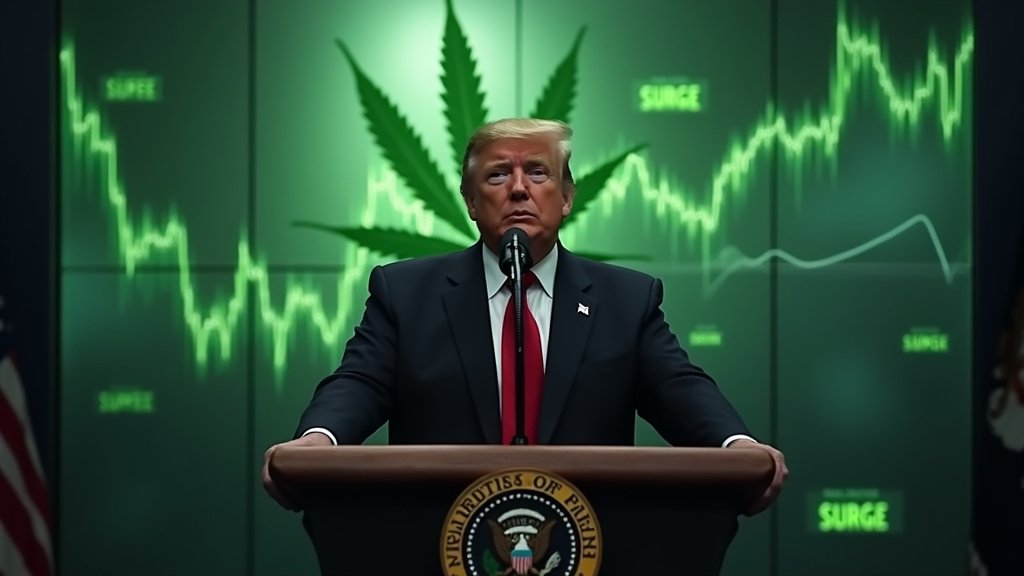
Washington D.C. – United States President Donald Trump has indicated his administration is on the cusp of a potentially seismic shift in federal drug policy, suggesting that cannabis could soon be reclassified as a less dangerous substance under federal law. The announcement, made to reporters at the White House on Monday, August 11, 2025, sent immediate reverberations through financial markets, triggering a significant surge in cannabis-related stocks.
President Trump stated that a decision on the matter could be made within the next few weeks, underscoring the urgency and proximity of a move that has long been a subject of intense debate among lawmakers, medical professionals, and industry stakeholders. The news immediately became a trending topic across financial and political circles, marking a pivotal moment in the ongoing discussion surrounding federal drug reform.
The Rigors of Schedule I: A Historical Burden
Currently, cannabis is classified as a Schedule I drug under federal law. This classification, which places it alongside substances like heroin and LSD, implies a stringent legal standing: the federal government deems Schedule I drugs to have no accepted medical use and a high potential for abuse. For decades, this categorization has severely restricted research into cannabis, hampered state-level cannabis industries, and led to a complex patchwork of state-federal legal conflicts.
Critics of the Schedule I designation argue that it flies in the face of scientific evidence and the growing acceptance of cannabis for medical purposes in numerous states. A reclassification to a less restrictive schedule would not necessarily legalize cannabis nationwide, but it would significantly ease federal restrictions, potentially paving the way for more research, easier interstate commerce for legal cannabis businesses, and a recalibration of federal enforcement priorities.
Market Euphoria: Stocks Soar on Trump’s Comments
The financial sector was quick to react to President Trump’s surprising announcement. Cannabis-related stocks experienced a dramatic and immediate uptick, reflecting investor optimism about the potential for expanded markets and reduced regulatory hurdles. Companies prominently featuring in this surge included Tilray Brands, which saw substantial gains, alongside Village Farms International and Canopy Growth Corp, both of which also recorded significant increases in their stock value. The sudden influx of capital into the sector highlights the immense financial implications of any federal reclassification.
Industry analysts are closely watching these developments, noting that a federal policy shift could unlock billions in new investment and reshape the competitive landscape for cannabis enterprises across the nation. The prospect of cannabis moving to a lower schedule has injected a fresh wave of excitement and speculation into what is already a rapidly evolving market.
Trump’s Nuanced Stance: Benefits and Concerns
While hinting at a potential reclassification, President Trump’s comments also showcased a nuanced perspective on cannabis. He acknowledged the positive aspects of medical cannabis, an increasingly accepted therapeutic option for a range of conditions from chronic pain to epilepsy. This recognition aligns with the views of a growing number of medical professionals and patients who have experienced the benefits of cannabis for medicinal purposes.
However, Trump also expressed concerns about its broader societal impact. This duality suggests that while his administration may move to ease federal restrictions, it is likely to do so with an eye towards mitigating potential negative public health or social consequences. Such a balanced approach could involve continued regulation, public health campaigns, or other measures to address the social implications of a more accessible cannabis market.
Echoes of Previous Efforts: Biden’s Attempt and Future Outlook
The discussion around cannabis reclassification is not new. Notably, former US President Joe Biden had previously proposed reclassifying cannabis to Schedule III, a less restrictive category than Schedule I. However, despite the proposal, his administration did not enact the change during his tenure. This historical context underscores the significant bureaucratic and political hurdles involved in altering federal drug scheduling.
President Trump’s current contemplation of such a move, coming after the Biden administration’s unfulfilled proposal, signals a potential breakthrough in what has historically been a deeply entrenched federal stance. The upcoming weeks will be crucial as the nation awaits further news and a definitive decision from the White House, a decision that promises to reshape the legal, medical, and economic landscape of cannabis in the United States and could set new precedents for future drug policy news.