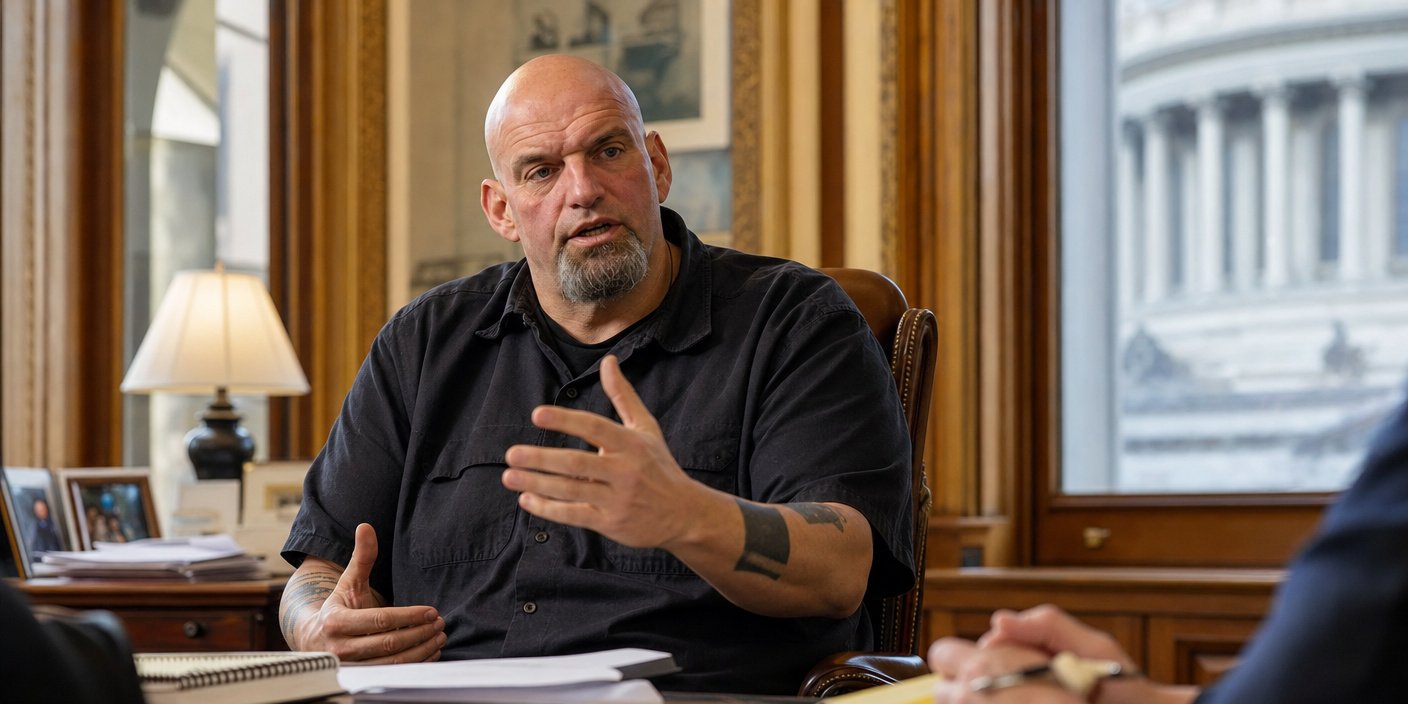
Senator John Fetterman has issued a direct challenge to the United States Congress, demanding immediate action to dismantle the outdated federal prohibition of cannabis. In a series of high-profile appeals, the Pennsylvania Democrat is championing a legislative framework that moves beyond mere decriminalization, advocating for a full descheduling of cannabis and its regulation, modeled after the frameworks governing alcohol and tobacco. This proposal does not stop at legalization; it aggressively targets the modernization of federal policy, including specific provisions for hemp protections and the creation of standardized, science-backed impairment testing that has long been a stumbling block for federal reform.
The Mechanics of Reform: Descheduling and Regulation
At the core of Fetterman’s advocacy is the fundamental restructuring of how the federal government classifies cannabis under the Controlled Substances Act (CSA). Currently categorized as a Schedule I substance—placing it in the same legal bracket as heroin—cannabis remains federally illegal, despite broad legalization across individual states. Fetterman argues that this classification creates an untenable conflict between state sovereignty and federal law, hindering research, commerce, and criminal justice reform.
His proposal suggests moving cannabis to a regulatory model similar to that of the Alcohol and Tobacco Tax and Trade Bureau (TTB). This shift would allow for interstate commerce, uniform tax structures, and the ability for legitimate businesses to access the traditional banking system—a persistent “pain point” for the industry. By treating cannabis as a consumer good rather than a criminal threat, proponents believe the government can effectively undercut the illicit market while generating significant tax revenue that could be allocated to public health initiatives or substance abuse education.
Strengthening the Hemp Industry
An often-overlooked, yet critical component of Fetterman’s proposal, is the explicit protection for the hemp industry. Since the passage of the 2018 Farm Bill, hemp-derived cannabinoids—most notably CBD and more recently, intoxicating isomers like Delta-8 THC—have existed in a murky legal “gray area.” Fetterman’s plan seeks to clarify federal standards for hemp, ensuring that farmers and processors have a stable regulatory environment. This protection is vital for the agricultural sector, as it provides the legal certainty needed to scale production and innovation without the constant threat of DEA intervention or sudden regulatory shifts.
The Impairment Testing Dilemma
Perhaps the most technically complex aspect of Fetterman’s push is the call for federal standards in impairment testing. Unlike alcohol, which has a universally accepted metric (Blood Alcohol Concentration or BAC) for impairment, cannabis currently lacks an equivalent standard that can differentiate between chronic use and acute intoxication. This ambiguity has been the primary argument used by law enforcement and conservative lawmakers against legalization.
Fetterman’s proposal aims to force the Department of Justice (DOJ) and the Department of Transportation (DOT) to accelerate research into impairment detection. The goal is to move beyond subjective field sobriety tests and develop reliable, rapid, and non-invasive technologies—such as saliva-based testing—that can objectively measure current impairment. By establishing these standards federally, Fetterman aims to assuage safety concerns, effectively neutralizing one of the final remaining hurdles to national legalization.
The Economic and Political Landscape
To understand the gravity of Fetterman’s proposal, one must analyze the broader economic and political context. For decades, the prohibition of cannabis has been a cornerstone of federal drug policy, but the shift in public opinion has been seismic. Recent polling indicates a strong, bipartisan majority of Americans support legalization, a trend that is finally beginning to penetrate the halls of Congress.
The Economic Ripple Effect
If the federal government were to follow the model proposed by Senator Fetterman, the economic impact would be immediate and profound. Legalization would unlock the ability for cannabis entities to operate like any other business, including the ability to claim federal tax deductions (currently prohibited under IRS Section 280E). This would drastically increase profit margins for operators and encourage institutional investment, which has largely stayed on the sidelines due to legal risk. Furthermore, the creation of a standardized federal market would likely drive down consumer costs through increased competition and supply chain efficiency, effectively starving the black market of its primary revenue stream.
A Shift in Political Polarization
Politically, the cannabis issue is undergoing a realignment. While traditionally a progressive cause, the argument for legalization is increasingly being adopted by libertarian-leaning conservatives who prioritize state rights, economic freedom, and reduced government overreach. Fetterman is banking on this cross-aisle appeal. By framing the issue as one of regulation and safety—rather than just criminal justice reform—he is attempting to build a coalition that can bypass the traditional partisan gridlock that has stalled legalization efforts for years.
Historical Context: From Prohibition to Potential
It is important to remember that federal prohibition was not always the status quo. The Controlled Substances Act of 1970 was a product of a specific political era, one that Fetterman characterizes as fundamentally flawed. By pushing for a pivot, he is not just proposing a new bill; he is challenging the legacy of the “War on Drugs.” This historical pivot would mark one of the most significant changes in US administrative law in the last century, signaling a transition from a punishment-based model to a commerce-and-safety-based model.
FAQ: People Also Ask
How does Fetterman’s proposal differ from current state laws?
While states have legalized cannabis individually, they are operating in violation of federal law. Fetterman’s proposal aims to create a federal supremacy framework that allows for interstate commerce and national standards, effectively removing the legal risk that currently plagues cannabis businesses operating across state lines.
What are the specific protections for the hemp industry?
The proposal seeks to codify clear distinctions between hemp and marijuana, ensuring that hemp growers are not subjected to the same restrictive enforcement as cannabis operations, while also providing a stable regulatory roadmap for the burgeoning hemp-derived cannabinoid market.
Why is impairment testing a key part of this legislation?
Currently, law enforcement lacks a universally accepted, scientifically validated roadside test for cannabis impairment equivalent to a breathalyzer for alcohol. Fetterman argues that federal legalization requires federal standards for safety, and therefore, the government must take a lead role in funding and validating these technologies.
Is there bipartisan support for this legislation?
While full legalization still faces resistance from some traditionalists, there is growing bipartisan interest in the economic benefits of reform and the necessity of resolving the current regulatory mess. Fetterman is specifically tailoring his arguments to appeal to these pragmatic, non-ideological concerns.