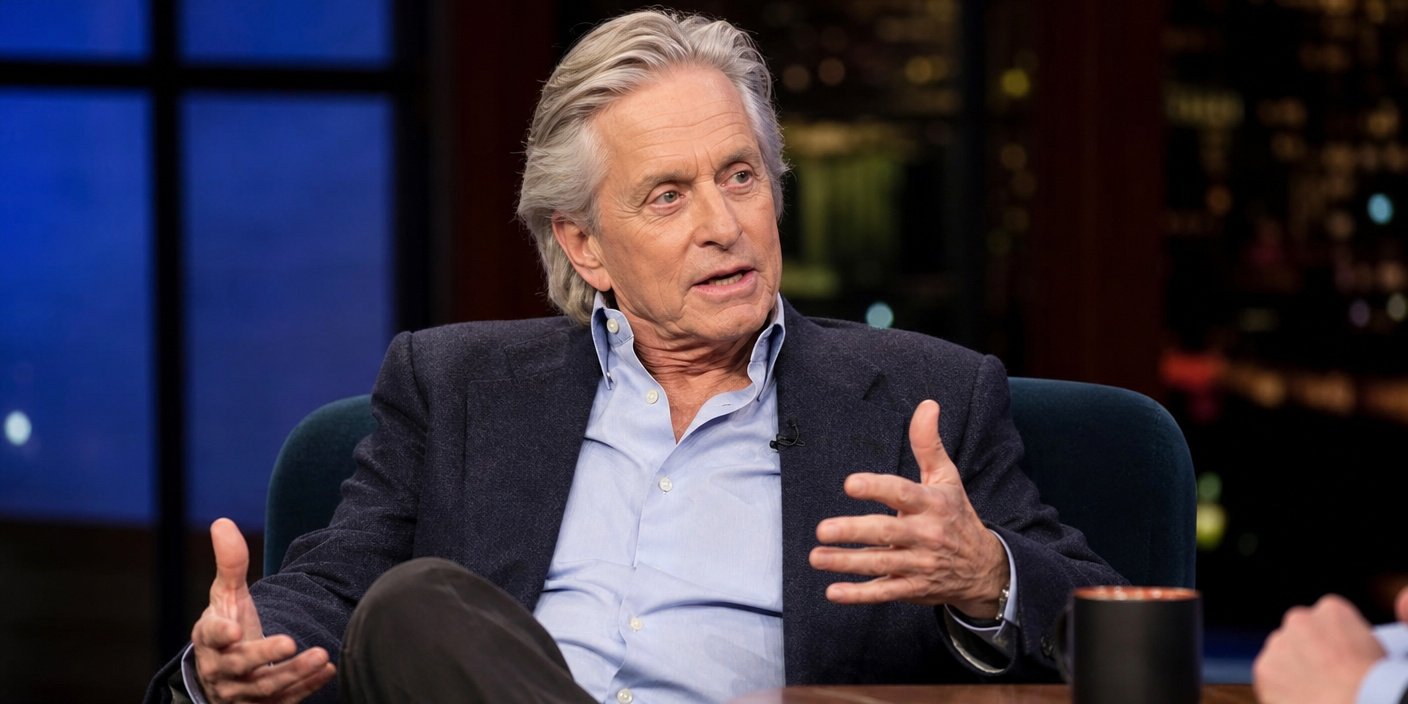
During a candid appearance on a recent episode of ‘Real Time with Bill Maher,’ Michael Douglas provided a rare glimpse into the formative, and surprisingly illicit, years of his life. Long before he became the face of ‘Wall Street’ or ‘Basic Instinct,’ the actor revealed that he navigated the financial pressures of early adulthood by smuggling marijuana between the U.S. East and West coasts. This confession, which has sent waves through entertainment media, sheds new light on the rigid financial upbringing imposed by his late father, the iconic Kirk Douglas, and the lengths to which a young, struggling actor would go to survive in the 1960s.
Key Highlights
- The Financial Cut-Off: Michael Douglas revealed that his father, Kirk Douglas, refused to provide financial support, forcing Michael to seek his own means of income early in his career.
- The Smuggling Operation: To fund his education and living expenses, the younger Douglas transported marijuana between the East and West coasts of the United States.
- Unveiling the Truth: The revelation came during an unscripted moment on ‘Real Time with Bill Maher,’ providing a stark contrast to his eventual image as a polished Hollywood A-lister.
- A Lesson in Independence: The anecdote highlights the complex, often demanding dynamic between the elder Douglas and his son, which ultimately fostered a sense of self-reliance.
From Hollywood Royalty to Coast-to-Coast Smuggler
The narrative of Michael Douglas’s life is typically framed through the lens of Hollywood aristocracy. As the son of Kirk Douglas, one of the most prolific and respected actors of the Golden Age, Michael’s trajectory into stardom was often perceived as a predetermined path paved with industry connections and inherent privilege. However, his recent admission on Bill Maher’s talk show challenges this simplified narrative, offering a raw, gritty, and undeniably human backstory that underscores the unpredictability of youth and the harsh economic realities of the 1960s.
The ‘Cut Off’ Strategy: Kirk Douglas’s Tough Love
For many, the idea of a Hollywood heir struggling for cash seems paradoxical. Yet, Michael Douglas emphasized that his father’s approach to parenting was characterized by a distinct lack of coddling. Kirk Douglas, having risen from extreme poverty during the Great Depression to become a cinematic titan, held a firm belief in the value of earned success. When Michael reached a certain age, the financial spigot was effectively turned off.
This decision was not born of malice but of a pedagogical philosophy intended to instill resilience. The ‘cut off’ was a pivotal moment for Michael, forcing him out of the comfortable orbit of his father’s fame and into the precarious landscape of a young, aspiring actor in New York and Los Angeles. It is in this vacuum of support that the smuggling operations took root—a desperate, yet pragmatically organized, attempt to maintain his independence while pursuing his craft.
The Logistics of a 1960s Inter-Coastal Hustle
The 1960s and early 1970s represented a volatile era in American history, particularly regarding drug culture and law enforcement. Douglas’s operation, though described with the casual demeanor of a man reflecting on a distant, youthful folly, speaks to the specific economic conditions of the time. Moving product between the East and West coasts required a level of logistical planning and risk assessment that, while dangerous, was not uncommon among the counter-culture youth of the era.
For Douglas, this was not about the romanticized ‘lifestyle’ often associated with trafficking in modern media. It was transactional: it was the rent money, the tuition, and the sustenance that allowed him to remain in the city and audition for roles. It illustrates a fascinating duality: the man who would eventually portray a high-flying financier in ‘Wall Street’—a character defined by greed and market manipulation—began his career in a different kind of grey market, one that prioritized survival over profit margins.
Reconciling the Past and the Public Image
The revelation also serves to humanize Douglas, who has maintained a remarkably consistent public profile for decades. By owning his past, including the illicit activities of his youth, Douglas mirrors a trend in modern celebrity transparency. In an era where ‘truth’ is a curated commodity, these unvarnished admissions act as a form of grounding. They serve as a reminder that even the most established figures in the Hollywood hierarchy are products of a complex, and often messy, journey.
This story does not merely highlight a youthful indiscretion; it serves as a bridge between the generations. It connects the rugged, stoic determination of Kirk Douglas to the polished, experienced career of Michael Douglas, showing that the ‘Douglas work ethic’—for better or worse—was a force that drove them both, even if the methods employed were radically different.
Economic and Cultural Context: The ‘Nepo Baby’ Debate
It is worth noting how this story impacts the ongoing cultural conversation regarding ‘nepotism’ in entertainment. While the term is often applied broadly to children of celebrities, Douglas’s story provides a nuanced counterpoint. While his name undoubtedly opened doors, the initial years of his life were characterized by a lack of access to his father’s capital. This highlights the distinction between ‘fame by association’ and ‘financial security.’ Michael’s willingness to discuss his smuggling days suggests that while the name helped, the struggle for survival was authentic.
The Evolution of Hollywood Finance
Lastly, the shift in how drug culture is viewed in the U.S. provides a backdrop to this confession. When Douglas was moving marijuana in the 60s, the legal risks were severe, yet the cultural acceptance in certain circles was growing. Today, with legalization sweeping across the United States, the confession feels less like a shocking ‘crime’ and more like a period-piece anecdote. It underscores the massive evolution in American law and social norms, where an activity that could have derailed a career before it started is now discussed with the ease of a talk show segment.
FAQ: People Also Ask
Q: Did Michael Douglas face legal consequences for his past smuggling?
A: Douglas has not detailed any specific legal run-ins or arrests regarding these activities, framing his recollection primarily as a means of survival and independence during his youth.
Q: How did Kirk Douglas react to his son’s behavior?
A: While Michael has not disclosed his father’s reaction to this specific revelation, he has frequently discussed his father’s ‘tough love’ approach, suggesting that Kirk prioritized self-reliance above all else.
Q: Is there any evidence that this influenced his acting roles?
A: While he has never explicitly stated that these experiences directly influenced a specific role, his life experience arguably provided him with a deeper understanding of characters operating on the fringes of societal norms, a depth that has defined much of his career.