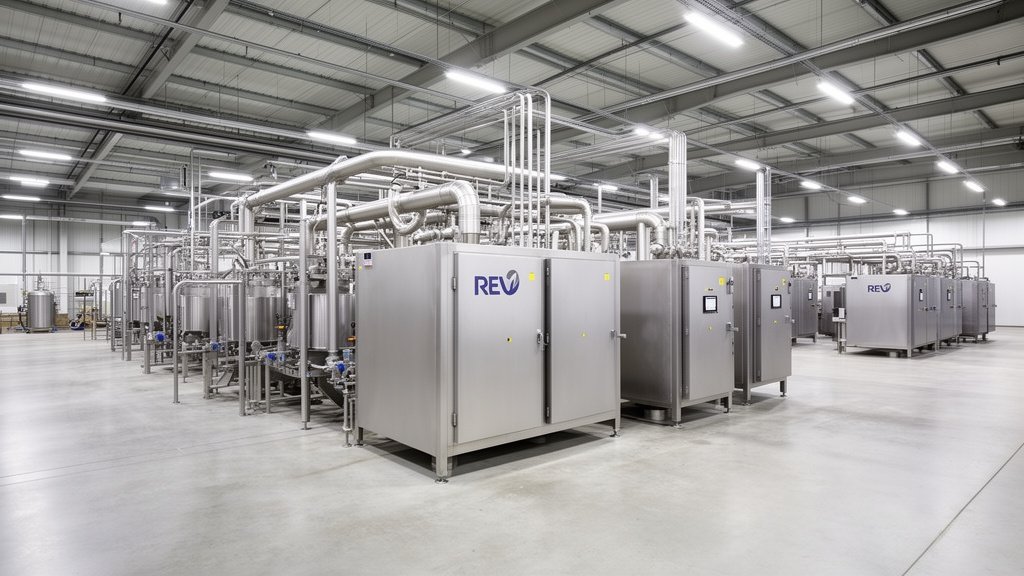
EnWave Corporation, the innovator behind the proprietary Radiant Energy Vacuum (REV) drying technology, has announced the closure of its REVworx co-manufacturing division. This strategic move signals a significant evolution in the company’s business model, as it moves away from in-house production to focus exclusively on its lucrative and scalable technology licensing network. The facility, which was originally established in 2022 to serve as a proof-of-concept and a showcase for commercial-scale REV drying capabilities, has fulfilled its mandate of demonstrating the viability of the technology to the broader food processing market.
Key Highlights
- Strategic Pivot: EnWave is shuttering its REVworx co-manufacturing division to align operations with a high-margin, asset-light licensing strategy.
- Mission Accomplished: The REVworx facility, launched in 2022, successfully achieved its goal of showcasing commercial-scale Radiant Energy Vacuum (REV) technology to prospective clients.
- Market Maturation: The company cites that its global network of licensed partners now provides adequate production capacity to meet existing and anticipated demand, rendering an internal manufacturing facility redundant.
- Focus on Core Competency: By exiting co-manufacturing, EnWave intends to concentrate resources on machine sales and technology royalties.
The Strategic Rationale Behind the Closure
For EnWave Corporation (TSX-V: ENW), the decision to wind down REVworx is not a contraction of its business, but rather a reflection of the company’s growth. When the division was first conceived in 2022, the food processing landscape was still skeptical regarding the scalability of vacuum-microwave drying technologies. The industry needed a tangible, high-capacity demonstration to understand how REV technology could revolutionize the drying of snacks, fruits, and pharmaceutical ingredients. REVworx served as this vital “showcase” asset, effectively proving that the technology could handle industrial volumes with superior efficiency, retention of nutritional value, and flavor profile preservation.
Validating the Technology Through Implementation
The fundamental challenge for any proprietary industrial technology is bridge-building—connecting the laboratory phase to mass-market adoption. REVworx bridged this gap. By operating as a co-manufacturer, EnWave was able to produce commercial-grade products for various third-party brands. This hands-on operational period provided invaluable data regarding energy costs, throughput, and maintenance requirements. Most importantly, it served as a functional showroom for potential licensees. As major food processors observed the success of the REV process through the REVworx operations, they became increasingly eager to license the technology directly for their own internal manufacturing lines.
A Shift to Intellectual Property-Centric Operations
With a robust network of licensed partners now firmly established across the globe, the economic calculus has changed. The overhead costs associated with maintaining a high-capacity manufacturing facility—labor, energy, facility maintenance, and compliance—are significant. By offloading these responsibilities to licensed partners, EnWave can optimize its balance sheet. The company’s business model is now laser-focused on three pillars: selling REV machinery, collecting recurring royalties from licensees, and providing technical support for existing installations. This transition essentially moves EnWave from an operational-heavy model to a high-margin intellectual property model, which is historically more attractive to institutional investors and scalable in the long term.
The Impact on the Licensee Network
The closure of REVworx does not imply a reduction in the availability of REV-dried products. In fact, it suggests the opposite. The rationale provided by EnWave indicates that the total volume of production capacity provided by their network of licensees is now sufficient to saturate the market and meet ongoing demand. These licensees—ranging from specialized snack food producers to large-scale commodity processors—have invested in their own REV infrastructure. As these partners continue to expand their product lines, EnWave’s technology remains the essential component of their value chain. The closure effectively removes EnWave as a competitor to its own clients; where previously EnWave might have been competing for co-manufacturing contracts, they are now strictly a technology provider, aligning their interests perfectly with their licensees.
Future Implications: What Lies Ahead
As EnWave navigates this transition, the focus will likely turn toward further technological refinement. Without the distraction of day-to-day manufacturing operations, the engineering team can dedicate more time to research and development. Advancements in REV technology—such as further reducing energy consumption and increasing moisture removal efficiency—will likely remain the primary drivers for new license agreements.
Furthermore, the move signals a broader trend in the food-tech sector: the transition from “proof-of-concept” to “industrial standard.” When a company can close its primary showcase facility because the industry at large has adopted its tech, it serves as a strong endorsement of the technology’s maturity. EnWave investors will be watching closely to see if this reduction in operational overhead translates into improved profit margins in upcoming quarterly reports. The shift is, in every sense, a graduation from being a pioneer of the tech to being an established standard-bearer in the industrial drying landscape.
FAQ: People Also Ask
Q: Why is EnWave closing the REVworx division?
A: EnWave is closing REVworx because the facility successfully met its objective of showcasing commercial-scale REV drying technology. With an established global network of licensed partners now providing sufficient production capacity, the company is pivoting to focus exclusively on its licensing and machine sales business model.
Q: Does this closure mean EnWave is struggling financially?
A: No. The closure is described as a strategic move to optimize business operations. By moving away from the operational costs of co-manufacturing, EnWave is concentrating resources on its higher-margin licensing model, which involves collecting royalties and selling proprietary technology.
Q: What happens to the products currently being produced at REVworx?
A: The production capacity has been replaced by EnWave’s network of licensed partners. These partners are fully capable of handling the volume and product requirements that were previously serviced by the REVworx facility.
Q: Will EnWave continue to innovate in the drying space?
A: Yes. The company stated that focusing on its core technology licensing model allows for greater emphasis on machine sales and technical support, which inherently includes ongoing innovation and development of their Radiant Energy Vacuum (REV) platform.